Types of Predicting Questions for Reading an Article
Reading Comprehension Strategy Series: How To Teach Students to Make Predictions While They Read
Adept readers make predictions naturally, without even knowing it. They predict what a book volition be nearly based on the title, they predict why characters human action a sure mode, and they gauge what volition happen next when they get to the end of a affiliate.
It'due south important that teachers help teach young students to employ this same reading comprehension strategy as well.
But - it takes explicit instruction for students to begin doing this on autopilot.
Predicting helps keep the reader'southward heed engaged and activated as he or she works through a text. When students actively predict while reading, they stay connected to the text and can reflect upon, refine, and revise their predictions.
Let's dive in to how to model, practice, and appraise this reading comprehension strategy with your students.
Pssst…Want a super engaging and interactive way to have students practise predicting?
LINKtivity® Interactive Guides are EXACTLY what you need to make learning fun & attainable for all!
Get access to the Predicting LINKtivity® (+60 others and counting!) within of LINKtivity® Learning - an all-access pass to our unabridged vault of LINKtivities!
Below are the dissimilar categories inside this post to assistance you lot jump to exactly what you lot need! Click on each category title to navigate there directly:
<< Back to categories
what you need to know before teaching the predicting reading strategy:
Predicting requires the reader to do ii things: i) utilise clues the author provides in the text, and 2) use what he/she knows from personal experience or knowledge (schema). When readers combine these two things, they tin can make relevant, logical predictions.
When students make predictions, nosotros want them to be able to justify their thinking. In their predictions, we desire to hear students drawing from both the text and their ain schema. Asking students to justify their predictions, keeps them accountable for their thinking and helps them have their thinking deeper.
Readers should make predictions before, during, and after reading. There are several different kinds of predictions that a reader tin make with a text. Readers can:
-
predict what the book will exist about (Reader apply titles and encompass illustrations, etc.)
-
predict the author's purpose (Is the writer trying to convince us of something? Does the author want to teach usa something? etc.)
-
predict future events in the book (Reader bases these predictions on previous events or grapheme words and deportment)
-
predict why an writer included a specific text feature (What does it teach us? What information does it help analyze?)
-
predict what they will learn from the text or department within a text (Reader uses titles, headings, and subheadings to inform predictions)
-
predict what would happen adjacent at the end of the book if it were to keep
Predicting involves more merely trying to effigy out what will happen adjacent. In fact, predicting requires students to draw on a variety of other secondary skills. As students look for evidence for their predictions, they too ask themselves questions, reread the text, recall information given in the text, infer, and depict conclusions.
Making predictions helps set the stage for students to monitor their own comprehension. Making predictions naturally encourages the reader to want to continue reading in order to find out if their predictions were correct or not. Past making predictions and then reading on to see if those predictions were correct helps to let the students know if their thinking was on the right rails. Using the prediction strategy correctly, truly volition result in comprehending the text more than fully.
<< Back to categories
INTRODUCING THE Predicting reading STRATEGY TO STUDENTS
The concept of predicting will most probable not be new to students. Activating this skill while reading, however, may require some practice. Since students may not be stopping to make predictions as they read, explicit educational activity to train students to do so is essential.
You can introduce this reading comprehension strategy with a simple exercise. Tell students that you are going to play a quick game that volition require them to estimate what you are going to do side by side in your schoolhouse 24-hour interval.
Explain that yous are going to go out and re-enter the room, providing clues as to what you are going to practise next. Here are 2 example scenarios that you lot might utilize:
-
When you lot re-enter the room, grab a soccer ball (or other playground equipment), put on your glaze, and grab your whistle. Take students predict what yous are going to do adjacent (go out for recess).
-
When you re-enter, get to your desk-bound and pull out your current read-aloud book and take a seat where you ordinarily share your read-aloud with the form. Have students predict what you are going to practice next (read-aloud to the class).
In either case, have students share out the clues that they used to make their guesses. Explain that when students fabricated a approximate as to what yous were doing next, they were making predictions. Tell students that readers make predictions all the time in the books that they are reading by using clues that the author gives them, and by using their own personal cognition. In the scenarios above, the students used the clues from your actions plus their noesis from past experiences to make their guesses equally to what you were going to do next.
<< Back to categories
MODELING HOW TO Make Predictions WHILE READING
Once students are in the mindset of making predictions, y'all can begin modeling through a read-aloud. Pic books work well, even with older students, to help model this strategy from start to finish.
To set for modeling this strategy, cull a text that works keen with making predictions. (see book suggestions at the end of this instructor guide). Preview the text and programme for places that you volition finish to model making predictions. If desired, write your predictions on Mail-it notes and place them on the pages where you program to share your predictions.
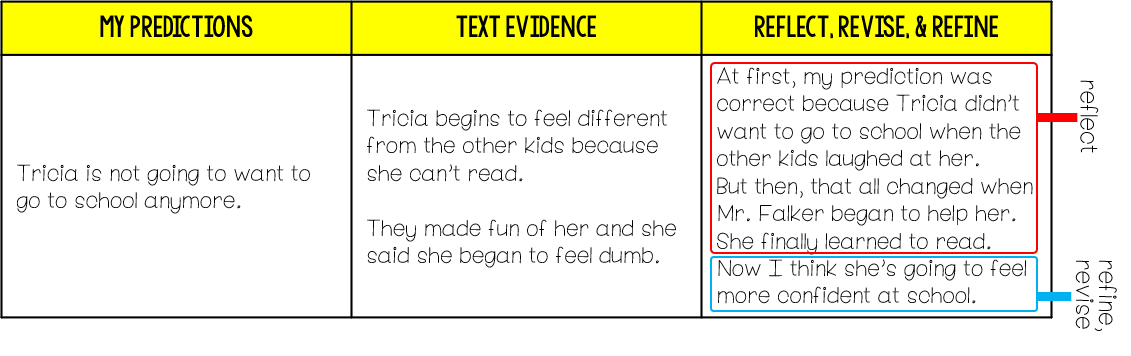
Create an anchor chart, like shown beneath, to record your predictions together as a class. (Note: For younger students, you can simplify this chart past putting only writing "reflection" in the tertiary column)

While reading your text to students, cease to discuss your predictions. Write your predictions on your chart (or place up your prepared Post-it notes) for students to run across in the "My Predictions" column. Discuss WHY you made each prediction. So, in the "Text Testify" cavalcade, record evidence from the text that helped inform your predictions. Every bit you read, fill out the "Revise, Refine, and Reflect" section for each prediction to notation whether or not your predictions were correct, and how it informed your thinking. Explain that as you reverberate on your predictions, sometimes you demand to refine (brand more clear), or fifty-fifty revise (change) your predictions based on new information that the author may requite you. Here's an example using the volume Thanks, Mr. Falker by Patricia Polacco: (affiliate link)
When first starting out, it might be helpful to give students some thinking prompts to help guide their predictions. Here are a few examples:
-
I think ________ volition happen because _________
-
I bet _______
-
I'm guessing _______
-
Since ____ happened, I think that _______ will happen
-
I think the graphic symbol will ___ considering _______
-
I think I volition learn ______
Another matter to focus on with students while making predictions is helping students make logical predictions that make sense. Over again, you will need to model this specifically. Model both logical and not logical predictions. For example, when reading Thank You, Mr. Falker a logical prediction might be: "Since Tricia has been staying afterwards school with Mr. Falker, I predict that she will finally acquire how to read." A prediction that is not logical would be: "I predict Tricia will read the book The Iii Little Pigs ." The second prediction does not apply any text clues to form the prediction. Although it is about Tricia reading, nothing in the text suggests that reading The Three Little Pigs would be a logical prediction.
Struggling readers often make predictions that are not logical by but choosing something remotely related to the topic or outcome in the book. This is why it is so important to assistance students rely on text testify when making predictions as well equally reflecting on each prediction. Help students to use phrases such as: "this prediction makes sense because in the text is says…" or "this is a logical prediction considering."
Model making predictions in both fiction and nonfiction texts. In fiction texts helps students to brand predictions nearly what the book might be about, what might happen side by side, or what a character might say or do. In nonfiction, students can predict what they might larn from the text, what information volition be included inside headings and subheadings, the definition of new content words, or why authors include certain text features.
<< Dorsum to categories
Choose TEXTS THAT ASSIST IN MAKING PREDICTIONS:
Of class we want students to be able to brand predictions regardless or what book they are reading. Still, as students accept their first experiences working this this strategy, choose books that lend themselves to makgin predictions volition help students to have a quick win, and easily encounter this strategy in action.
Be sure to choose a book that provide obvious opportunities for students make predictions. This volition help set students up for success and will train their brains to stop and call up about what is going on in the text in guild to brand logical predictions.
Here are some of my favorites to apply when modeling predicting (affiliate links):
-
Two Many Tamales by: Gary Soto
-
Enemy Pie by: Derek Munson
-
Those Shoes by: Maribeth Boelts
-
What Do You Exercise With a Tail Like This? past: Steve Jenkins
<< Back to categories
PRACTICING PREDICTING:
CREATE SIMPLE VISUALS TO REMIND STUDENTS TO PREDICT
When first using a new reading strategy, students need constant reminders. Visuals such as bookmark to apply while reading, or a classroom poster that is displayed on a reading strategy bulletin board work wonderfully to nudge students to make predictions while reading.
Continue to create ballast charts displaying the predictions that yous make during read-aloud texts. You tin even create a grade anchor charts where students post their own predictions about a book that you are reading together as a class.
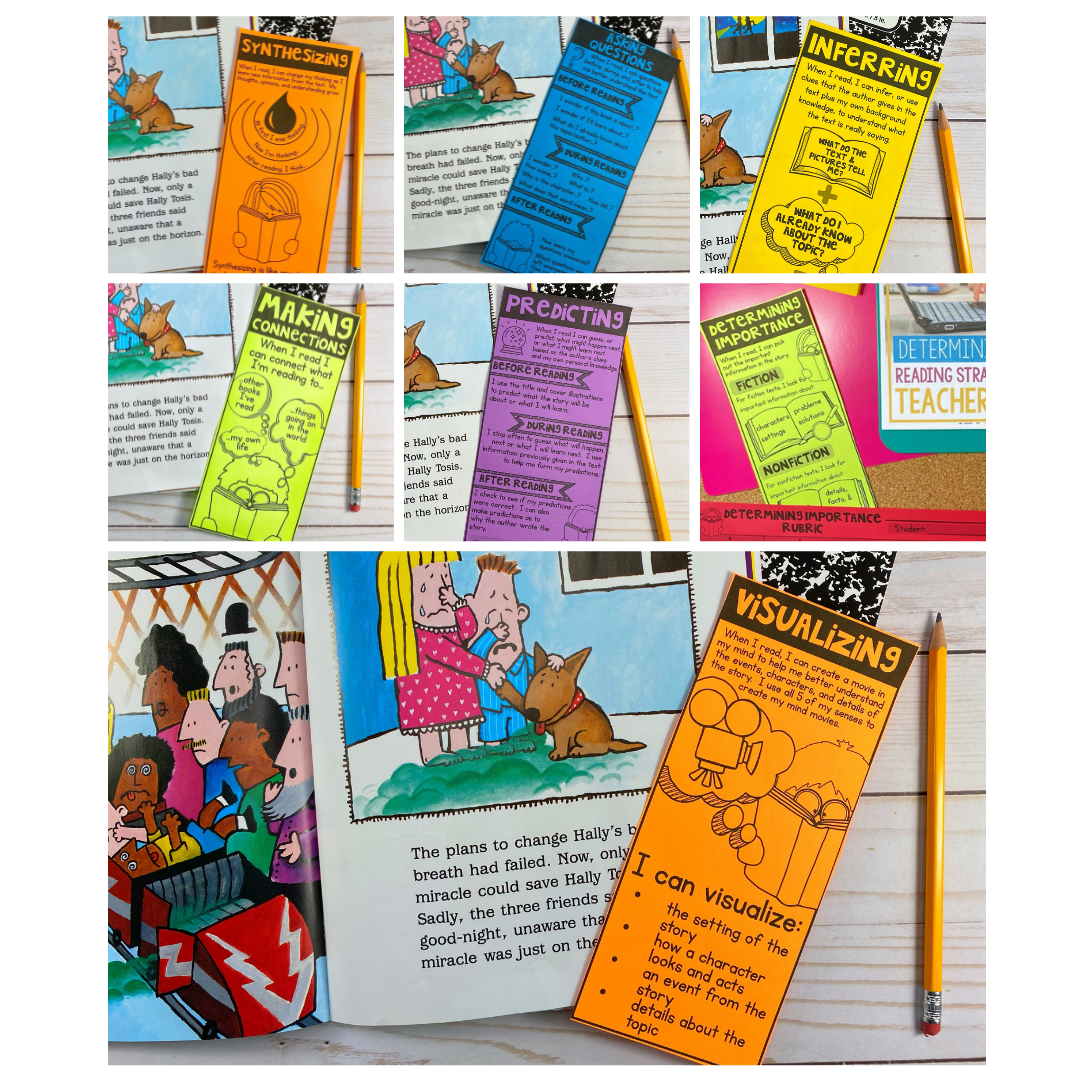
8 FREE Reading Strategy Bookmarks
Take hold of these Free student bookmarks to help your students utilize reading comprehension strategies while reading.
There are a total of viii bookmarks that explain reading strategy in child-friendly linguistic communication and is the perfect reference for students to use during contained or modest-group reading time.
Apply LINKtivity DIGITAL LEARNING GUIDES
New to LINKtivities? >> CLICK Here
If you know me, even just a little flake, then you know I'm near to talk about LINKtivity digital learning guides. Why? Considering LINKtivities are interactive, engaging, and so fun for learning and practicing new skills like reading strategies.
I created a LINKtivity® specifically for education students how to brand predictions while reading. Watch the video below for a sneak-peek!
Here's how it works:
In the Predicting LINKtivity, students first watch a curt animated video prune that quickly catches their attention with fun doodles and images. The clip introduces what the strategy is and how readers use information technology.
From there they read alongside their "virtual reading buddy" to encounter the strategy practical to a text. While clicking through the digital book, each time the student comes across a thought bubble, they click on it and are brought to a new slide in the LINKtivity guide to see what their reading buddy is thinking!
Then, to take their learning to the side by side level, students read 3 additional high-interest reading passages to practise the strategy on their ain. In a similar fashion equally they did with their reading buddy, students click through the digital storybook and stop to make predictions forth the fashion.
Accept STUDENTS KEEP TRACK OF THEIR PREDICTIONS WHILE READING
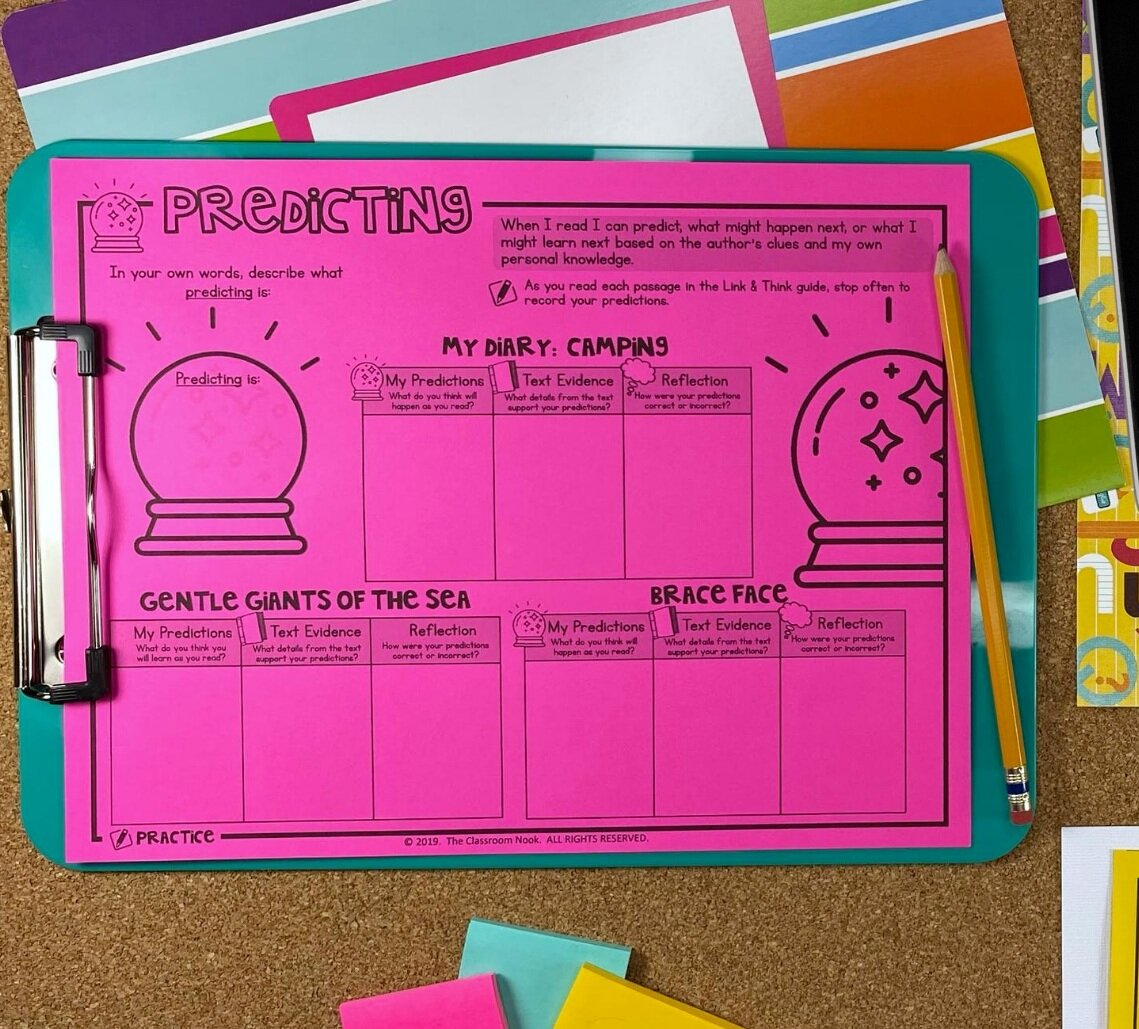
Having students write downwardly their predictions so reflect, refine, and revise them as they read, is key when it comes to informing you of their understanding of the strategy. From their written predictions y'all can encounter if their predictions are meaningful, relevant, and logical to the story that they are reading.
Writing down their predictions also keeps them accountable for their learning and gives you an breezy assessment.
<< Back to categories
ASSESSING YOUR STUDENTS ON MAking Predictions
Assessment, whether it be formal or informal, drives educational activity. For more informal assessments, take notes near a students utilise of the predicting strategy during reading conferences or in pocket-size groups. Considering the following when observing the students' utilise of the strategy:
-
Are students making predictions prompted or unprompted?
-
Can students support their predictions with text evidence?
-
Practise students draw on personal experiences to inform their predictions?
-
Are students monitoring if their predictions were correct or incorrect?
-
Are the students' predictions logical? Do they brand sense to the story?
Finally, having a rubric written in child-friendly linguistic communication is specially helpful when providing feedback to a student on their ability to make predictions. The rubric can provide articulate guidelines on how to make predictions while reading.

Want to become your hands on the Predicting LINKtivity®?
Bring together the LINKtivity® Learning Membership and start using this ready-to-go resource for predicting that includes:
-
a instructor guide
-
a pupil LINKtivity
-
a student recording sheet
-
a student-friendly rubric
Get admission to the Predicting LINKtivity® PLUS all the other reading comprehension strategies inside of LINKtivity® Learning - an ALL-Admission laissez passer to every single LINKtivity® created (INCLUDING all vii reading strategy LINKtivities!)
Check out the other posts in this serial
Source: https://www.classroomnook.com/blog/predicting
0 Response to "Types of Predicting Questions for Reading an Article"
Post a Comment